Types of Serrano Ham
The centrality of ham in Spanish cuisine becomes obvious when you look at the great variety of producers scattered throughout the Iberian Peninsula. Indeed, one could say that there are many types of Serrano ham as there are regions and towns in Spain. Obviously there are hams and hams: the less and the more and more expensive, some more juicy than others.
Let's review the different parameters used to classify Serrano hams. First of all, though, it should be stressed that Serrano ham refers only hams made from Ibérico pigs, usually Duroc, Landrace and / or Large White, although some may have been crossed with an Ibérico pig. This is definitely the main distinctive feature compared to Iberico hams.
The production area is one element that gives the most prestigious Serrano hams their cachet, and the truth is that we associate certain geographical areas with quality. The key to this identification is, on the one hand, the extensive experience of local producers, who can implement the knowledge passed from generation to generation, and, on the other, a mountain climate suitable for drying helps ensure success .
For this reason, traditional producers of Serrano ham are covered by the certification of Protected Geographical Indication (PGI), which includes all the national territory and regulates all the necessary parameters to ensure quality (fat thickness, minimum weights for slaughter, production processes, etc.).
These are the most important factors:
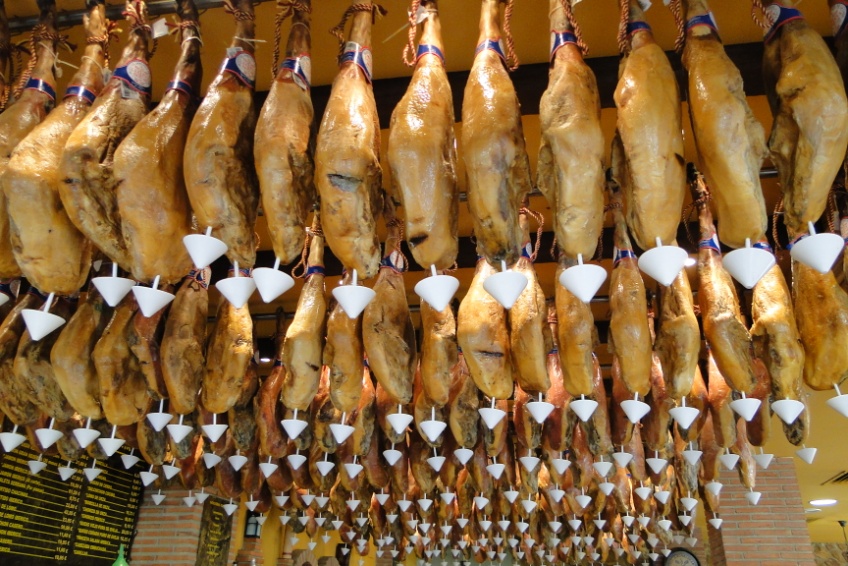
- Trévelez Serrano Ham: This occurs in several localities of the Alpujarra, including Trévelez. It is one of the most famous types of Serrano ham. Cereals are the staple food of these pigs, following the guidelines established by the IGP. These Spanish hams are characterized by their rounded shape and typically weigh between 7 and 9 kg. The meat has a deep red color and in tasting, the dominant notes are sweet due to low salt content.
- Teruel Serrano Ham: A total classic. Not for nothing was this the first Spanish ham to receive the Designation of Origin label in Spain. These hams are produced in the province of Teruel, in any zone that is over 800 meters above sea level. The hams have a round profile with a strong hip and elongated leg, usually weighing more than 7kg. Good hams of this type are slightly salty and sweet, with a bright pinkish color .
- Seron Ham: Originates in Almería and was recently included in the IGP registration. Usually a large, high-fat ham. Good examples are saltier than the other types of Serrano ham, while still offering a smooth texture and a sweet predominant flavor. One aspect that stands out is the wide range of aromatic flavors and aromas found during tasting.
These are the 'true' Serrano hams, but we must remember that many different hams are produced throughout the peninsula. For example, it would be a shame to neglect Avila ham, Murcia flat ham, the Pyrenees hams, Cañiza ham and many others.
The IGP regulates drying times and processes, which are the same for all types of serrano ham which are granted certification. Across types of Serrano ham, the major difference will be the change in quality brought about by curing time. Therefore a Spanish ham will be:
- Bodega: with a cure time between 9 and 12 months.
- Reserva: (Reserve) a curing time between 12 and 14 months.
- Gran reserva: (Grand Reserve) a curing time of more than 14 months.
These are the best Spanish hams to be found in the market. The longer curing time allows hams to develop nuances of aroma and taste, and therefore guarantee of success.
Todo sobre el jamón
Contenido
- 1 Tipos de jamón ibérico
- 2 Cómo consumir jamón ibérico
- 3 Cortar jamón ibérico
- 4 Cómo conservar el jamón ibérico
- 5 Maridaje del jamón ibérico
- 6 Ley de calidad del jamón ibérico
- 7 La Dehesa
- 8 Denominaciones de origen del jamón ibérico
- 9 Propiedades nutricionales del jamón ibérico de bellota
- 10 Recetas con jamón
- 11 Diferencias entre jamón ibérico y jamón serrano
- 12 Diferencias entre paletilla y jamón ibérico
- 13 Diferencias entre jamón ibérico y jamón serrano
- 14 Jamón ibérico y sus competidores en el mundo
- 15 Propiedades nutricionales del jamón ibérico
- 16 Denominación de origen del jamón ibérico
- 17 Zonas de elaboración del jamón y del jamón pata negra
- 18 Jamón cortado a mano o a máquina
- 19 Museos del jamón ibérico en el mundo
- 20 Cata de jamón ibérico: todos los secretos
- 21 Ruta del jamón ibérico
- 22 El jamón ibérico de bellota y su maridaje ideal
- 23 Proceso de elaboración de los embutidos ibéricos
- 24 Historia de los embutidos ibéricos
- 25 IVA para el jamón: preguntas y respuestas
- 26 El jamón en la literatura
- 27 Curiosidades del jamón ibérico
- 28 Cómo conservar el jamón serrano
- 29 Normativa de calidad del jamón serrano
- 30 Elaboración del jamón serrano
- 31 Denominaciones de origen del jamón serrano
- 32 Propiedades nutricionales del jamón serrano
- 33 Recetas con jamón serrano
- 34 Tipos de jamón serrano
- 35 Maridaje del jamón serrano
- 36 Cómo consumir jamón serrano
- 37 Cortar jamón serrano
- 38 Todos los secretos sobre la cata de jamón pata negra
- 39 Cómo elegir un buen soporte jamonero
- 40 Cuál es el mejor jamón pata negra?
- 41 Es correcto el término jamón pata negra?
- 42 Jamón pata negra y dehesa
- 43 Los secretos del maridaje del jamón pata negra
- 44 ¿Cómo saber qué jamón comprar?
- 45 ¿Por qué el buen jamón es tan caro?
- 46 ¿Cómo comprar jamón en tiendas online?
- 47 Mitos y realidades, beneficios y prejuicios del jamón
- 48 ¿El jamón ibérico engorda?
- 49 ¿Qué hacemos con el hueso del jamón?
- 50 ¿Por qué solemos colgar el jamón?
- 51 Jamón y embarazo: ¿Se puede incluir el jamón ibérico en la dieta de las embarazadas?
- 52 El rol del jamón en el crecimiento y desarrollo de los niños
- 53 Consejos para conservar el jamón
- 54 ¿Qué es el perfilado del jamón y por qué se hace?
- 55 Nuevas tecnologías y jamón - Resonancia magnética en la cata del jamón - Imágenes espectrales
- 56 El cerdo ibérico comienza a emigrar
- 57 Embutidos: Origen, composición y clasificación
- 58 Elaboración de jamones y paletas
- 59 Guía de Cata del Jamón Ibérico
- 60 Elementos diferenciales de calidad en jamón y embutidos “ibéricos”
- 61 El mapa del jamón en España
- 62 Propiedades de la grasa del jamón ibérico
- 63 Cómo transportar jamón ibérico y otros alimentos en vuelos internacionales
- 64 Prevalencia de patógenos y beneficios de los ácidos orgánicos en la producción de cerdos